
R2C2 - Pseudo-continuous fiber reinforcement made from recycled raw materials for ceramic matrix composites with innovative performance profiles and enhanced sustainability
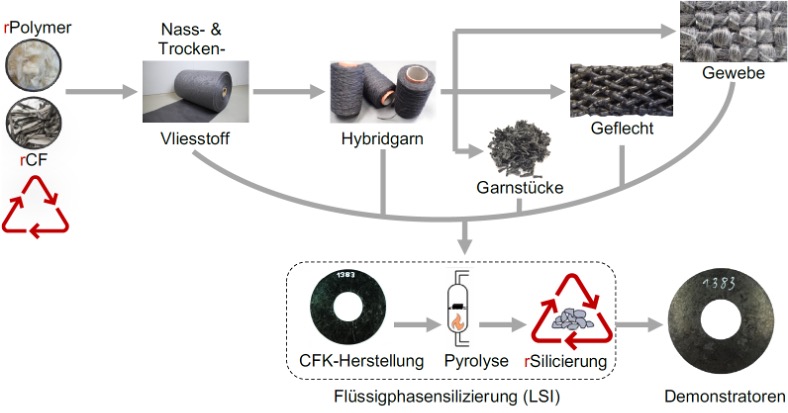

The project aims to reduce the CO2 footprint by at least 75% in the production of C/C-SiC composite ceramics. This will be achieved through the use of recycled materials and improved manufacturing processes. The goal is to significantly reduce the CO2 footprint in the production of C/C-SiC composite ceramics using the Liquid Silicon Infiltration (LSI) process. Through innovative methods for utilizing recycled raw materials and new approaches in the production of textile semi-finished products, the project aims to achieve a cost reduction of at least 30% in fiber and process costs.
A key aspect involves transforming irregular raw materials—such as mm- to cm-long recycled carbon fiber segments—into processable intermediate products using textile processes. To this end, discontinuous wet or dry nonwovens made from recycled carbon fibers (rCF) and, where possible, recycled PEEK materials are being developed. These nonwovens are then further processed into quasi-continuous anisotropic fiber reinforcements. The dry nonwovens are used to produce hybrid yarns consisting of rCF and a PEEK matrix, which are then used to manufacture CFRP bodies that are converted into C/C-SiC via the LSI process.
In addition, the mechanical properties, thermophysical characteristics, and corrosion resistance of the resulting composite ceramics are being investigated in various gaseous media, including H₂+CO (syngas).
The use of cost-effective recycled materials and the reduction of process costs make it easier for small and medium-sized enterprises (SMEs) to enter the composite ceramics industry. In addition to large-format ceramic brake discs, new applications are also emerging in the chemical and plant engineering sectors. The approaches to the production of textile semi-finished products offer new prospects for components made of (r)CF and open up additional markets for SMEs in the textile and paper industries without requiring extensive restructuring of existing production facilities.
Duration: 01.10.2025 - 31.03.2028
Grant reference number: 01IF0081AE
Funding Agencies: BMWE, IGF
Contact: Dr. rer. nat. Nico Langhof
Project Partners:
Research Center 1: University of Bayreuth
Chair of Ceramic Materials
Universitätsstraße 30
95447 Bayreuth
Project Leader 1: Dr. N. Langhof
Research Center 2: German Institutes for Textile and Fiber Research Denkendorf
Institute for Textile and Process Engineering
Körschtalstraße 26
73770 Denkendorf
Project Leader 2: Prof. Dr.-Ing. G. Gresser
Research Center 3: Fraunhofer Society for the Promotion of Applied Research e. V.
Fraunhofer Institute for Foundry, Composite, and Processing Technology IGCV
Am Technologiezentrum 2
86159 Augsburg
Project Manager 3: Prof. Dr.-Ing. K. Drechsler